

Waste collection operates as a city service that residents only acknowledge when it experiences operational failures. The system functions without detection until garbage collection services experience delays. It immediately results in a missed pickup. Overflowing bins together with unpleasant odors and sanitation complaints will spread through neighborhoods within a single day.
For municipal authorities, ensuring reliable waste collection across an entire city is not simple. Collection teams often need to cover thousands of households every day. Each route includes multiple streets, residential areas, and commercial zones. Even with well-planned schedules, missed bins or incomplete routes can occur.
This is where RFID based waste collection tracking is beginning to transform how sanitation systems operate. Instead of relying entirely on manual reports from collection workers, municipalities can now monitor collection activities digitally. Each waste bin can be tracked, each pickup recorded, and each route verified.
With the help of digital monitoring systems, municipal departments gain better visibility into daily operations. Over time, this helps cities move closer to achieving complete waste collection coverage. Clean and healthy urban spaces require this procedure as their fundamental operational requirement.
The Importance of Waste Collection Monitoring
The process of waste collection seems like a simple task. The process actually serves two vital functions because it protects public health and environmental integrity. The situation becomes critical when garbage collection delays occur because uncollected trash creates immediate problems.
The most prevalent problems created by inconsistent waste collection practices include the following:
● Residential areas experience garbage bins that exceed their capacity.
● Waste materials build up around market areas and public locations.
● Bad odors spread through neighborhoods.
● Increased presence of insects, rodents, and stray animals
● Waste materials enter drainage systems, which results in system blockages.
● Residents submit sanitation complaints to local authorities.
The situations require effective waste collection monitoring through door-to-door methods. Municipalities need to provide consistent collection services to all households while making sure their collection routes cover every neighborhood.
Supervisors use proper monitoring methods to assess the performance level of collection teams. It provides clarity on whether routes are being completed and whether operational adjustments are needed.
Challenges with Traditional Waste Collection Systems
Many cities still depend on traditional monitoring systems that rely heavily on manual processes. Collection staff complete their assigned routes and later report their work through paper records or verbal updates.
The method has provided successful results for multiple decades, but its several limitations create obstacles that prevent effective monitoring of performance.
The organization faces multiple challenges, which include:
i. Limited verification: Supervisors often rely on reports without direct proof that a bin was collected.
ii. Missed pickups: The route will skip a location, which will remain hidden until residents file complaints about the situation.
iii. Low operational visibility: Authorities cannot easily track the progress of collection vehicles during the day.
Manual systems create data gaps, which produce untrustworthy information for evaluating route performance and waste distribution patterns.
Many municipalities face challenges to sustain their garbage collection operations because of these problems. The implementation of RFID based waste management solutions by cities improves their waste management operations through enhanced transparency and accountability.
Understanding RFID Technology in Waste Management
RFID, or Radio Frequency Identification, is a technology used to identify and track objects using radio signals. The technology has found extensive application across supply chain operations and inventory management processes as well as logistical tasks.
RFID technology enables waste management organizations to monitor the complete process of waste bin movement and collection operations.
The system typically includes three main components:
1. RFID tags attached to individual waste bins or containers
2. The readers are installed on waste collection vehicles.
3. A central monitoring system that records and stores the data
Each RFID tag contains a unique identification number linked to a specific bin or location. The RFID reader automatically scans the tag when a waste collection vehicle arrives to lift the bin.
The system then records important details such as:
● The location of the bin
● The time the bin was collected
● The collection vehicle involved
● The route being followed
Through RFID based waste collection tracking, municipalities gain a reliable digital record of every waste collection event.
How RFID Based Waste Collection Tracking Works
RFID technology integrates directly into daily waste collection operations. The system performs automatic background tracking after installation.
The process usually works as follows:
1. RFID tags are installed on waste bins
Every waste bin is fitted with a small RFID tag. This tag serves as a digital identity for that particular bin or collection point.
The tag contains a unique code that represents:
● A household
● A street location
● A commercial waste container
● A public waste collection point
2. RFID Readers Are Installed on Collection Vehicles
The waste collection trucks have built-in RFID readers which enable them to identify and read nearby RFID tags. The devices have the ability to identify and read RFID tags which are located within their detection range.
The reader is traditionally positioned close to the truck’s lifting system which enables automatic tag scanning whenever the bin is raised.
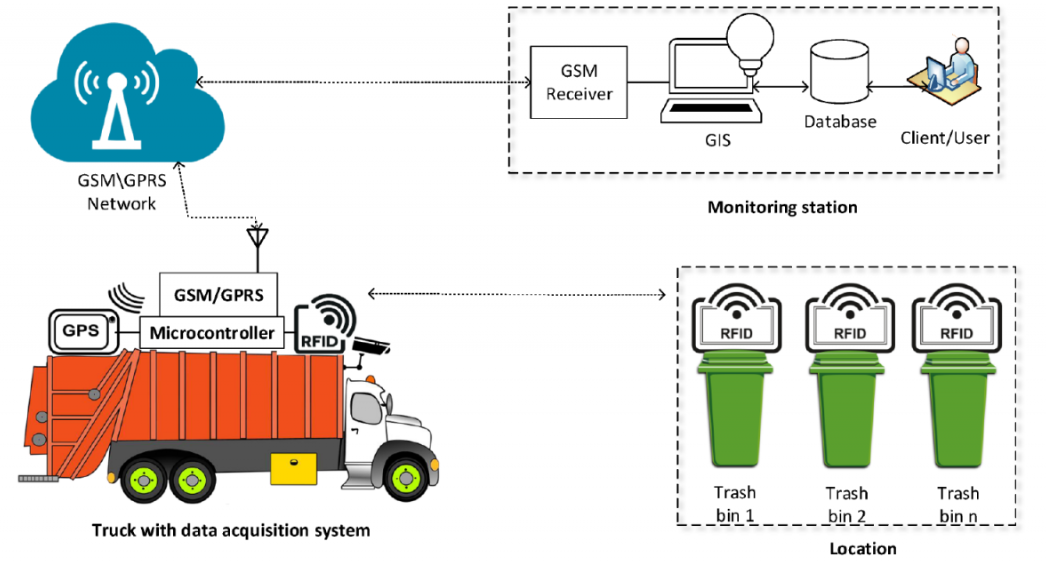
How RFID Based Waste Collection Tracking Works
3. Automatic Scanning During Collection
The RFID reader immediately scans the tag when a sanitation worker lifts the bin to empty its contents into the truck.
This scan triggers a digital record that includes:
● Bin identification number
● Time of collection
● Vehicle identification
● Route information
4. Data Is Sent to a Central Monitoring Platform
The recorded data is transmitted to a central monitoring system where supervisors can review the collection activity.
A digital dashboard allows authorities to see:
● Which routes have been completed
● Which bins have been serviced
● Which areas still require collection
5. Supervisors Can Identify Missed Locations
If a bin is not scanned during the collection route, the system highlights it as missed. Supervisors can then instruct collection teams to return and complete the service.
This system greatly improves door to door waste collection monitoring because it provides clear digital evidence of each pickup.
Key Benefits of RFID-Based Waste Management Solutions
There are several different benefits that come with using RFID based waste management solutions. It is essential for municipal waste management departments. Some of the major benefits include:
The system tracks waste collection activities by using digital tracking technology, which monitors all collection activities. The system enables supervisors to verify whether bins were emptied according to the established service schedule.
● Increased Accountability
The use of RFID records enables organizations to track their operational performance. Authorities can investigate problems that occur when routes are not finished or when bins are not collected.
● Better Route Optimization
RFID systems collect data that helps to identify waste production patterns and collection performance. The information helps municipalities create routes that reduce vehicle travel distances and lower fuel usage.
● Door-to-Door Waste Collection Monitoring
Cities can use these tracking systems to enhance their ability to monitor waste collection services. The system guarantees that all waste collection work will reach every household in the area.
● Data-Driven Decision Making
Municipalities receive operational data from RFID systems, which provide essential information to their operations. The municipalities can use this information to improve their resource allocation and vehicle management and their methods of delivering services.
● Greater Transparency in Municipal Operations
The digital documentation system enables sanitation departments to produce complete records, which help them maintain transparency while building public confidence.
RFID waste management solutions improve waste collection operations through enhanced organization and operational efficiency and better accountability.
Conclusion
The efficient collection of waste materials serves as a critical requirement. It is required for sustaining both cleanliness and public health throughout urban environments. The existing traditional monitoring systems face difficulties in keeping up with the needs that arise from growing urban populations.
The use of RFID-based waste collection tracking, together with digital verification processes in sanitation operations, provides municipalities with an effective method to enhance their tracking capabilities and their proof of system operation. The system enables automatic pickup registration, which assists cities in their task of monitoring all areas during waste collection operations.
The implementation of technology-based waste management systems will serve as a crucial factor for urban areas. Places that aim to create cleaner and more sustainable communities by extending their boundaries. If you are looking for a right partner who provides such extensive RFID- based digital waste collection contact us at: +91 8800443333