

Attendance might look like some routine thing, but in a manufacturing setup, it touches way more than just employee check-ins. Each attendance record sort of becomes part of payroll, shift planning, overtime math, and overall workforce availability. When attendance isn’t captured in a clean way, even a small mismatch can start a chain reaction… causing annoying delays, payroll rework, and extra follow-up work for HR teams.
For years, biometric fingerprint machines were the usual option for marking attendance. They let companies move away from those paper registers and manual entries, which made attendance management feel more organized, more orderly. Still, the way manufacturing units run these days is not the same as a decade back. Now factories handle bigger teams, multiple shifts, contract workers, and operations that sit across different sites.
So, in this kind of environment, businesses need attendance systems that can actually match the tempo. This is exactly where AI based attendance management systems are stepping in. With facial recognition plus smart automation, they let organizations log attendance more accurately, while also cutting down on the manual load and improving day-to-day workforce control.
Manufacturing Has Changed, Attendance Systems Need to Change Too
Manufacturing units today run in this fast-moving environment where every minute really does matter. If there is a delay at the very start of a shift, it doesn’t only mess with attendance, it can also ripple into production schedules, machine utilization, and even workforce planning for the rest of that day.
Now picture the first shift in a typical factory.
Hundreds of employees show up, more or less, in a short window. Some go straight to the production floor, while others just hang around near the attendance machine. A few people clock in smoothly, but others need several attempts before the fingerprint scanner finally recognizes them. And by the time everyone is inside, there is already a line forming at the entrance.
This happens more often than people think.
Factory workers spend their day dealing with machinery, raw materials, tools, oils, and chemicals. Over time, the fingerprints can become harder to read in a steady way. Dust, grease, moisture, or even tiny cuts on the hands can throw off how well fingerprint-based systems perform, sometimes dramatically.
Even if each delay is just a few seconds, those seconds stack up fast when hundreds of employees are coming into the facility every single day.
For growing manufacturing businesses, attendance should support operations moving faster, not turn into a bottleneck, slowing everything down.
Why Attendance Is Becoming a Business Priority
Attendance management is no longer just about recording when employees enter or leave the workplace.
Every attendance entry now slips into a far larger pipeline, as if it becomes part of something bigger.
Payroll teams depend on clean attendance records to figure out salaries and overtime payments. Production managers also need clarity on whether each shift has enough people before operations kick off. HR teams lean on attendance insights for leave control, absenteeism tracking, and workforce planning.
When that attendance information is wrong or a little off, every department ends up feeling it in one way or another.
Even a missed attendance entry can trigger salary corrections. Incorrect overtime details usually bring employee follow-ups and questions. On top of that, manual checking eats up HR time that could otherwise go toward recruitment, employee engagement, or compliance tasks.
For organizations handling hundreds, or even thousands, of employees, these “small” mistakes can turn into repeatable operational headaches.
That is one of the biggest reasons companies are moving past traditional attendance systems now.
They aren’t really chasing more technology.
They’re chasing fewer attendance-related problems, more reliability, and less hassle overall.
What Is an AI Based Attendance Management System?
An AI based attendance management system is built to make taking attendance quicker, simpler, and more precise. Instead of relying only on fingerprint verification, these systems often rely on face recognition tech to figure out which employees are who, and then record everything automatically. Employees just walk past a camera and, within a few seconds, the system confirms identity and logs it.
The biggest advantage isn’t only speed, you know. It’s also consistency, steady behavior, that kind of thing. With typical biometric setups, performance can wobble when conditions are not ideal, but AI Face Recognition Attendance Systems still work in places where fingerprints are hard to read or scan. That’s why ai based attendance system with face recognition for manufacturing units is really useful for warehouses, construction sites, and other busy workplaces where people are doing physical, demanding tasks all day.
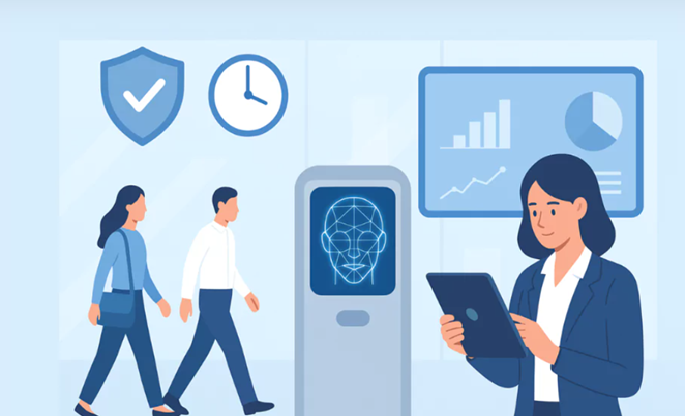
Most newer attendance management software with AI-enabled face recognition that includes connection with payroll software, HR platforms, and shift management systems. Attendance entries get updated on their own, so there is less manual data entry , and HR teams can handle workforce information from one central dashboard.
So overall, employees get a smoother attendance flow, while management gets fewer admin headaches and less repetitive work.
The Benefits Go Beyond Attendance
One of the biggest reasons businesses are switching to AI Attendance Management Systems is that the advantages really go way beyond just recording employee attendance. It basically helps to simplify all those regular tasks that somehow keep taking up a lot of time for HR and operations teams, even when nobody wants to admit it.
Take payroll as an example. Before salaries are processed, attendance records usually need to be reviewed. Missing entries, incorrect punches, overtime approvals, and shift changes often mean manual checking is required. And sure, one correction might only take a few minutes, but the workload grows pretty fast once hundreds of employees are involved, so it turns into this daily headache.
An AI-based attendance management system cuts down a bunch of those manual steps by capturing attendance more accurately right from the beginning. That typically leads to fewer corrections, fewer payroll disputes, and, honestly, more trust in the attendance records. Like, it’s cleaner, and there’s less back and forth.
Another improvement people notice quickly is the employee experience. Nobody really enjoys waiting in line before starting work. With AI-powered face recognition attendance systems, employees can finish attendance fast without having to stop and scan fingerprints again and again. The whole thing feels simple, contactless, and it takes only a few seconds.
Managers also end up benefiting because they can access attendance information anytime they need it. Whether it’s checking who showed up for a shift, looking at absenteeism, or preparing workforce reports, the data is right there instead of searching through piles of records, spreadsheets, or whatever else is being used.
For businesses that keep growing, these smaller upgrades pile up over time. Less manual labor, fewer attendance-related problems, and better visibility help teams focus on running operations rather than spending their energy fixing attendance issues again.
Why Indian Manufacturers Are Moving Towards AI in 2026
Manufacturing in India is kind of evolving at a quick pace, faster than before. A lot of businesses are pushing ahead, expanding their operations, opening new facilities, and managing bigger workforces than ever, all at once. Alongside that, there’s this steady pressure to boost productivity while still keeping day-to-day operating costs under check.
In that mix, attendance management has turned into a real part of the conversation. Manufacturers today just can’t really tolerate delays around shift changes, and they also don’t want to spend hours every month fixing attendance records before payroll is even processed. What they need are solutions that are dependable, fairly simple to oversee, and able to handle large workforces without turning HR life into a constant mess.
So it’s no surprise that AI-Enabled Attendance Systems are getting more traction across industries. Unlike the older approaches, AI-based systems are made to help with multiple sites, different working schedules, and rising employee numbers, without making everything more complicated for HR teams.
Many organizations are also asking for something else like better integration with their existing HR and payroll software. Instead of holding separate ledgers, attendance data can flow straight into other workflows. That cuts down duplicated tasks and improves overall efficiency in a very practical way.
For a lot of manufacturers, the choice is not really only about replacing a legacy attendance machine. It’s more about putting money into a system that can support what comes next and future growth as well.
Choosing the Right AI Attendance Solution
Not every attendance system comes with the same kinds of features, so picking the right one really matters. You want an attendance management tool that includes AI-enabled face recognition but also stays practical. Like it should be simple enough for employees to use, while the HR team still has full, real control of the attendance files, not just partial access.
Also check if the solution handles multiple shifts, plus different office or plant locations. It should not be a hassle to connect with payroll and HR software either. As your staff increases, the platform should scale alongside your company, without forcing you into major rework or painful changes.
Another thing people tend to overlook is reporting. Attendance reports should be clear enough to read quickly and available when you need them. Managers ought to be able to look at attendance patterns, spot absenteeism early, and reach employee information directly without spending ages on manual data compilation, spreadsheets, or that sort of thing.
And finally, reliability, just don’t compromise here. Attendance is often the first moment employees have with your organization each day. When the system keeps working, day after day, employees get a smoother experience, and HR plus operations teams have less unnecessary admin to wrestle with.
Looking Ahead
The way businesses handle attendance is going to keep changing, like, in a natural sort of way. Companies seem to be moving away from setups that just track attendance and instead toward solutions that help with stronger workforce management. And since AI tech keeps getting better, these attendance systems should get even more accurate , easier to interact with, and more connected with other business tools.
For manufacturing businesses, that often translates into spending less time wrestling with attendance and more time focusing on productivity, supporting employees, and expanding operations. Attendance may still stay in the daily grind, sure, but how it gets managed is shifting. So the businesses that adapt early might end up getting the best long-term payoff, you know.
Final Thoughts
Manufacturing businesses have always leaned on accurate attendance records, but the expectations around how attendance is handled have shifted a bit over time. Today’s plants need systems that can handle bigger workforces, multiple shifts, and rising day-to-day pressure, without piling on extra admin tasks or paperwork. Traditional timekeeping methods did their job before, but in many modern manufacturing settings, they are just not sufficient anymore.
An AI-based attendance management system is a practical option to make attendance more accurate, cut down on manual grind, and make workforce administration feel simpler. When it’s paired with AI Face Recognition Attendance Systems , companies can build a quicker, more dependable, and more comfortable attendance routine, not only for employees but also for the management side.
As manufacturers keep moving toward automation and connected workplaces, attendance management is turning into a key part of that whole evolution. The firms that pick the right solution now will be set up better for whatever their workforce needs tomorrow.
Ready to Upgrade Your Attendance Management?
Looking for a smarter way to deal with employee attendance, like for real? Our AI based face recognition attendance system kinda helps businesses automate tracking , boost accuracy, and make workforce management feel more straightforward, even with all the day-to-day chaos. It uses secure facial recognition technology so attendance records stay reliable, rather than just guesswork.
Reach out to our team, and we’ll walk you through how AI-powered attendance can back your manufacturing operations, step by step, without the usual headache. To know more contact us now @ +91 8800443333.
Frequently Asked Questions :-
What is an AI Based attendance management system?
An AI-based attendance management system is basically a system, or maybe a process, that uses artificial intelligence along with facial recognition tech to capture employee attendance in an automatic kinda way. Instead of relying only on key cards, registers, or manual entry, it can identify people and record the punch. This way businesses get better attendance accuracy, less manual hassle, and a cleaner routine for workforce management.
Why do Indian businesses need an AI attendance management system in 2026?
Well, as companies keep growing and overseeing bigger teams, the older attendance methods start getting difficult to manage, keep updated, and verify consistently. AI Attendance Management Systems can support more accurate attendance, cut down payroll mistakes, and make it easier to handle employees across many branches, multiple work sites, and different shifts.
Is AI-based Attendance Management Software suitable for remote teams?
Yes, it actually fits pretty well for remote teams. Most modern attendance management software with AI-enabled face recognition can track attendance across different offices, project sites, remote setups, and other business locations. Then HR can view attendance data from one centralized platform ,instead of juggling reports from everywhere.
How does AI-based face authentication improve attendance accuracy?
An AI Based Face Recognition Attendance System checks employee identity using facial recognition, not fingerprints and definitely not hand written logs or manual entries. That reduces attendance errors, helps stop proxy attendance , and generally leads to more reliable attendance records.