

Every day, thousands of sanitation workers travel across the cities to pick up household waste. On paper, it looks kind of simple. But in real life, dealing with door-to-door waste collection is a lot more complicated than people think. The collection teams must sweep wide service areas, stick to fixed routes, make sure every single household gets visited, and finish everything by the deadline. For municipalities, the real problem is not only collecting waste it’s also confirming that the collection actually took place.
This is exactly why QR code household scanning solutions in waste management are now shifting how cities monitor collection work. If each household gets its own unique QR code, and each collection is logged by a fast scan, municipalities can watch what’s happening in real time. That improves responsibility, lowers the likelihood of skipped households, and makes the whole process more trustworthy.
As Indian cities keep expanding, digital monitoring is becoming just as important as waste handling itself. A QR Code Waste Management System gives local bodies the visibility they need to run daily operations more smoothly, while also improving day-to-day service delivery for citizens.
How does QR code household scanning work in solid waste management
A QR code household scanning solution in waste management allows municipalities to digitally Okay, so imagine a QR code household scanning setup for waste management; it kinda helps municipalities confirm every single home waste pickup without those old manual logs, or, well, relying on people saying “yeah, it was collected”.
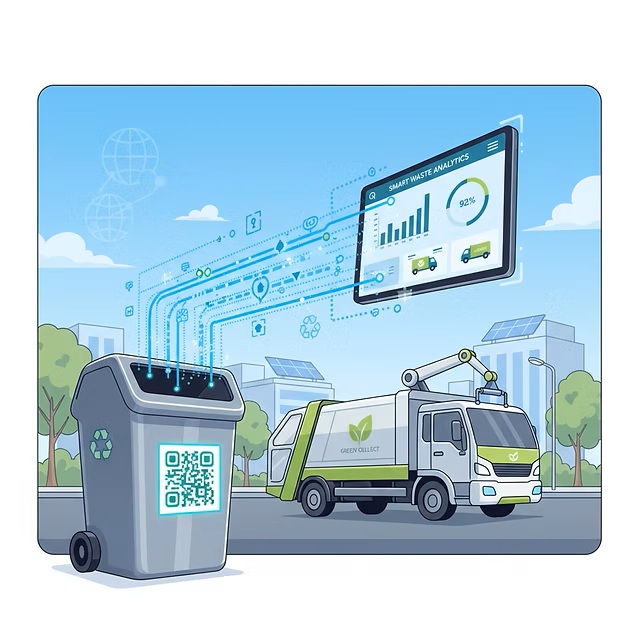
Each household gets a unique QR code that is tied to the waste management platform. Later, when the sanitation worker actually comes by and grabs the trash, they scan that QR code using a mobile device. It instantly logs the pickup, like it records the location plus time, and also the date, right away.
What matters is that this very basic flow lets the municipal teams follow the door-to-door collection more closely, check how wide the coverage is, and spot missed households before things get messy. It also keeps digital records tidy and up to date. And instead of waiting until the end of the day for supervisor summaries, managers can watch the collection work as it happens, then respond fast when there are service gaps or coverage issues.
Modern solid waste management solution in India, QR code household scanning brings more transparency. It strengthens responsibility, and supports better day-to-day planning for garbage collection operations.
Why Traditional Door-to-Door Waste Collection Needs Better Monitoring
Over the past few years, door-to-door waste collection has improved quite a lot across India. Most Urban Local Bodies (ULBs) now offer regular collection services to households , so waste collection is kinda more arranged than before.
Still, in many cities, supervisors often lean on manual registers, paper documentation, or phone-based updates to check if the collection teams have finished their assigned routes. This can be tolerable in smaller pockets, but once the coverage grows , like when thousands of households must be handled every single day, it becomes messy to manage fast.
Now picture a municipality that has to collect waste from more than 50,000 households. Even if only a small slice of homes gets missed during the daily run, you’ll see the outcomes quickly, and not in a good way. Overflowing bins, citizen complaints, and then the same streets getting revisited again and again. Without dependable tracking in place, spotting the missing areas tends to be a reactive task, not a proactive plan.
Then there’s the accountability part, which is its own headache.
When a resident says, “waste wasn’t collected,” supervisors usually do not have enough detail to verify whether the truck stopped at that exact spot. It could be that the vehicle was visited and nothing was taken, or it might have been skipped outright. To sort it out, people often end up doing manual checks, talking to field staff, and sometimes returning to the site, which costs time that could be used elsewhere.
As cities keep widening out, these challenges start to get even harder to juggle, you know, day to day.
In the World Bank’s What a Waste 2.0 report, it says the world is producing about 2.24 billion tonnes of municipal solid waste each year, and it is projected to climb up to 3.88 billion tonnes by 2050. Because urbanization is speeding up so quickly, municipalities aren’t just expected to collect more, but also to keep a closer eye on day-to-day operations in a smarter and more efficient way.
India is seeing a similar surge too, in the sense of urban waste generation. As per the Ministry of Housing and Urban Affairs (MoHUA), urban India generates over 1.5 lakh tonnes of municipal solid waste every day, so efficient monitoring becomes essential, for keeping dependable waste collection services running smoothly.
These figures highlight an important point.
Improving waste collection is no longer enough. Municipalities also need reliable ways to verify every collection, monitor field operations, and respond to issues before they affect residents.
What Is a QR Code Household Scanning Solution?
A QR code household scanning solution is a simple digital system that helps municipalities record and verify every household waste collection.
Each household is assigned a unique QR code, usually placed near the entrance of the property. Every sanitation worker is provided with a mobile application connected to the municipality’s waste management platform. Once waste is collected, the worker scans the QR code before moving to the next household.
The scan immediately creates a digital record showing that the collection has been completed. Depending on the system, it can also capture additional information such as GPS location, collection time, route details, and the identity of the sanitation worker.
Instead of depending on paper registers or manual reporting, supervisors receive live updates through a centralized dashboard. This makes door-to-door waste collection monitoring more transparent and much easier to manage.
The biggest advantage of QR code household scanning in India for solid waste management solution is its simplicity. The process requires very little training, works with standard smartphones, and can be integrated with existing municipal operations without disrupting daily collection activities.
More importantly, it provides something that traditional collection methods often lack, verified proof that every household has been serviced.
How QR Code Household Scanning Improves Waste Collection
The biggest advantage of the QR code household scanning type solution isn’t really the QR code itself; it’s the way it gives municipalities clearer visibility, kinda like a direct line.
In traditional waste collection, supervisors usually rely on manual reports to determine whether collection routes have been completed. If a resident says, “Pickup was missed” or something like that, then verifying the complaint can take quite a while since there isn’t much proof, like barely any evidence that the household was actually visited.
With a QR Code Waste Management System, each waste collection gets recorded at the instant a sanitation worker scans the household’s QR code. The system stores the collection time, the location, and the route details too , so officials get a verified digital footprint instead of relying on paper logbooks that can be incomplete or delayed.
That means supervisors can effectively monitor door-to-door waste collection in real time. So if a route ends up incomplete or a household is missed, corrective action can be triggered much sooner. And that helps lift service quality while also bringing down citizen complaints overall.
Benefits for Municipalities and Waste Management Agencies
A QR code household scanning solution in waste management helps municipalities improve daily operations without making the collection process more complicated.
Every completed scan creates a digital record, making it easier to verify collection activities and improve accountability. Instead of compiling manual reports, officials can access collection summaries, route performance, and ward-wise reports from a single dashboard.
The system also supports better planning. Collection data helps identify areas generating more waste, routes that require additional resources, and locations where collection schedules need improvement.
Complaint handling also becomes easier. If a resident reports that waste wasn’t collected, officials can quickly check the scan history. They can verify the collection status and respond faster.
Why More Indian Cities Are Adopting QR Code-Based Waste Collection
Urban waste management is becoming more challenging as cities continue to grow. Larger residential areas and increasing waste volumes require municipalities to monitor collection activities more effectively.
Government initiatives such as the Swachh Bharat Mission (Urban) have encouraged local bodies to adopt digital technologies. Something that improves service delivery and transparency. As a result, many cities are introducing household scanning using QR code in India as part of their solid waste management solution in India to strengthen collection monitoring and improve accountability.
Digital verification gives municipalities better control over field operations while helping ensure that waste collection services remain consistent across all households.
QR Code Monitoring vs Traditional Collection Tracking
The difference lies in the usage of each component. There are places where operations are stuck to traditional ways of usage and others are on QR code scanning. Lets understand the major difference between the both processes.
| Traditional Monitoring | QR Code Household Scanning |
| Manual records | Digital verification |
| Delayed reporting | Real-time updates |
| Difficult to verify collections | Instant scan history |
| Time-consuming complaint handling | Faster issue resolution |
| Limited operational insights | Better reporting and monitoring |
QR code household scanning works better than traditional monitoring as people have digital records available. All this without manual errors and efforts.
Conclusion
Waste collection is no longer just about clearing garbage from households. Municipalities also need reliable ways to confirm that every collection has taken place and every route has been completed.
A QR Code Waste Management System helps achieve this by replacing manual verification with accurate digital records. It improves accountability, simplifies reporting, and gives municipal teams better visibility into daily operations.
As more cities invest in smarter sanitation services, QR code household scanning solutions in waste management are becoming an important part of modern solid waste management solutions in India. By helping municipalities track door-to-door garbage collection more effectively, these solutions support cleaner neighbourhoods, better service delivery, and more informed decision-making.
Ready to Modernize Your Waste Collection Operations?
Convexicon QR Code Waste Management System helps municipalities and waste management agencies digitize door-to-door waste collection monitoring with real-time household scanning, centralized reporting, and complete operational visibility. Whether you’re managing a municipal corporation, smart city project, or private waste collection service, our solution helps improve accountability while making daily waste collection easier to manage. To know more contact us now @ +91 8800443333.