

As cities grow, managing waste has become tougher in ways most people don’t really see until it’s too late. With Smart Solid Waste Management Solutions, Municipalities are able to upgrade their waste management system efficiently while adopting newer technologies such as GPS, IoT, RFID, etc.
The World Bank states that there were approximately 2.56 Billion Tones (Billion tonnes) of municipal solid waste generated globally in 2022, which may reach 3.86 billion tonnes (Bn tons) by 2050. Therefore, it becomes critical for every city to have efficient smart solutions in place to manage increasing waste production.
The use of digital technologies through Solid Waste Management Solutions helps in tracking the entire waste management process easily. It improves overall service quality and reduces operational costs significantly.
In this blog, we’ll cover what you should know about modern waste management, starting from the basics of solid waste and municipal waste management, then moving toward the technologies that are helping Indian cities create cleaner, better, and more organized communities.
What Is Solid Waste Management?
A solid waste management solution involves the complete process of collecting, source segregation, transporting, sorting, smart routing software, recycling, treating, and safely disposing of discarded materials that comes from households, businesses, institutions, and public places.
The goal is not just to take waste away from streets, but to handle it in a responsible way through its whole lifecycle, from start to end- no shortcuts.
A modern waste management system usually has:
- Waste segregation at the source
- Door-to-door collection
- Transportation using collection vehicles
- Transfer stations
- Material Recovery Facilities, also called MRFs
- Recycling and composting
- Scientific disposal of the stuff that can’t be recycled
Today’s Municipal Waste Management systems also aim at reducing landfill waste by pushing recycling, composting, and resource recovery. That way the environment gets better protection, while recyclable materials get better use, more or less.
Why Is Solid Waste Management More Important Than Ever?
The need for an efficient municipal waste management system has never been greater as our cities grow bigger. Every city needs an effective waste management plan that ensures both the safety of citizens’ lives and their surroundings.
Poorly handled municipal solid waste (MSW) poses serious health threats to urban dwellers due to its ability to pollute air, land, and water sources if left unchecked. In addition, neglected MSW contributes significantly to various diseases because of potential contamination risks.
Municipal waste management includes several key aspects ranging from ensuring timely garbage removal procedures to encouraging recycling efforts among local populations, aiming towards decreasing reliance on landfills altogether. Efficient handling strategies ultimately help maintain clean neighborhoods while conserving valuable community resources simultaneously through improved utilization planning processes involving available public money supply allocations.
Something meant specifically to enhance overall sanitation quality levels achieved within each municipality’s jurisdiction area boundaries, respectively.
Why Traditional Waste Management Is No Longer Enough
Older waste management systems were mostly built for cities with smaller populations and less waste showing up every day. Nowadays, though, municipalities are dealing with thousands of households, residential belts growing outward, more shops and offices, plus lots of public places too, so the manual workflow becomes harder and harder to keep running.
Still, quite a few local bodies depend on paper-based logs, fixed pickup days, and people checking things by hand to follow what goes on day to day. Sure, this gives some basic monitoring, but it does not really show what is happening once the collection vehicle actually leaves the depot, because there’s no real insight into the route after that point.
For instance, supervisors may not immediately notice if a truck skipped a piece of the assigned path, or if it sat there idling for a long time, or if it got stuck with delays from traffic conditions or mechanical problems, until residents start complaining about collections that never happened.
On top of that, trying to gather operational data manually makes it awkward to estimate labour productivity, fine-tune the collection routes, or pin down the same recurring service voids in different zones.
So instead of only adding more refuse trucks or hiring additional sanitation staff, municipalities need sharper intel so decisions can be made quicker and with less guesswork. That’s exactly where Smart Solid Waste Management Solutions give a real advantage.
What Are Smart Solid Waste Management Solutions?
A Solid Waste Management Solution is like an integrated digital platform that helps municipalities handle every stage of waste collection and processing via real-time monitoring, plus connected tech. It kinda brings things together, not as separate silos, more like one continuous flow.
Instead of treating collection, transportation, processing, and reporting as separate activities, smart systems bring everything together on one platform, so you get a clearer view.
This means municipal officials can watch field operations, follow collection vehicles, confirm household collections, manage complaints, create reports, and analyse performance, all without relying on manual updates.
The whole point of these solutions is not to swap sanitation workers, or anything like that. It’s more to help them work more efficiently by giving reliable information, cutting down paperwork, and improving the coordination between teams that usually don’t talk enough.
Modern Waste Management Solutions India (focus on source segregation, decentralized composting, waste-to-energy conversion, advanced recycling and digital Extended Producer Responsibility (EPR)) is assisting municipalities in moving from reactive operations toward data-driven decision-making, so they can plan better and deliver more consistent public services.
Technologies That Power Smart Waste Management
A modern waste management setup brings together a few technologies, and they kinda work as one unit to boost efficiency across basically the whole waste lifecycle, from start to finish.
GPS Fleet Tracking
With GPS, municipalities can keep an eye on collection vehicles in real time. This lets officials check routes, spot any slowdowns, cut down unnecessary travel, and optimize fuel usage, while also making sure the collection schedule is actually met and not just assumed.

QR Code Household Scanning
QR codes linked to specific households let sanitation workers confirm each pickup digitally. The end result is a more reliable service record. It also improves accountability, and yes, it reduces the need for manual checks, which is… time-consuming.

RFID-Based Monitoring
RFID helps automatically recognise waste bins, vehicles, and other collection assets. It boosts operational precision and, importantly, it trims down manual data entry that can easily get messy or slow.
IoT Waste Management Solutions
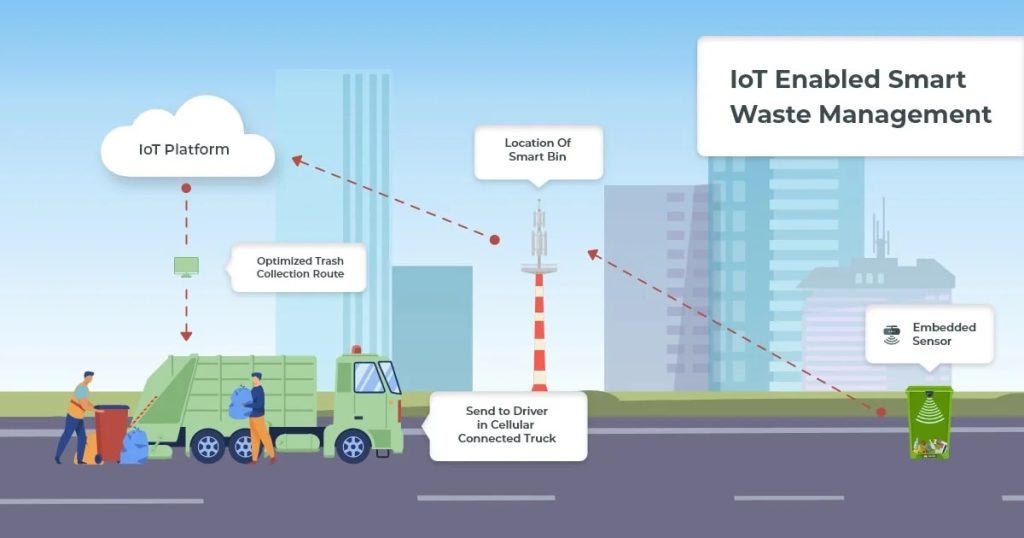
IoT sensors gather live info from waste bins, vehicles, and related equipment. Municipalities can then watch fill levels, equipment health, and day-to-day performance metrics. That means faster reactions to issues and better planning later on, even before problems grow.
Centralised Dashboard and Analytics
All the data from GPS, QR scanning, RFID identification, and IoT sensor readings gets pulled into one central dashboard. Officials can track progress, read reports, analyse trends, and make decisions based on up-to-date information, rather than relying on manual estimates or delayed summaries.
When these tools run together like that, municipalities get full visibility over waste management operations, and the whole system becomes more transparent, plus more efficient, overall.
How Smart Solid Waste Management Works
A smart waste management system links pretty much every stage of the waste lifecycle through one single digital platform, and it kind of keeps everything in sync.
It starts when waste is produced, and people sort it at homes, businesses, and institutions. After that, sanitation workers pick it up using routes that are already planned out. During collection, activities can be checked using QR codes or RFID tech, and GPS-enabled vehicles let supervisors watch the routes and even track vehicle movement in real time, which helps a lot.
Once the waste is gathered, it gets moved to transfer stations or processing centers. There, recyclables are separated, organic waste goes to composting, or it can be converted into energy, while the stuff that can’t be recycled is directed toward scientific disposal.
All the while, municipal officials get real-time information via one central dashboard. So instead of waiting for end-of-day summaries, they monitor the work as it unfolds, they handle delays faster, and they steadily refine service delivery.
This connected model helps cities shift away from manual waste collection into intelligent Solid Waste Management Solutions. It helps support smarter planning, more responsibility, and smoother municipal operations overall.
Benefits of Smart Solid Waste Management Solutions
The biggest advantage of Solid Waste Management Solutions is that they end up improving the whole waste management process, not just dealing with one small problem. When collection vehicles, sanitation workers, monitoring systems, and reporting get connected into one single platform, municipalities can make quicker decisions and deliver better public services.
Better Operational Efficiency
With smart waste management systems, you get real-time visibility into day-to-day operations. Municipal officials can keep an eye on collection vehicles, confirm finished routes, and spot delays, without leaning on manual updates. So there is better coordination between the field teams, and it also helps ensure waste is picked up on time.
Lower Operational Costs
Waste collection is among the most costly municipal services. Fuel, vehicle maintenance, manpower, and all those repeated trips make up a huge chunk of day-to-day expenses. With tools like GPS tracking and route optimisation, unnecessary driving gets reduced, idle periods are minimised, and vehicle utilisation improves a lot. That means operating costs stay lower overall.
Improved Accountability
Digital verification using QR codes, RFID, and GPS tracking creates more reliable records of collection work. Instead of relying on paper registers or verbal back and forth, municipalities can confirm services using real-time information. This increases transparency while also making it easier to handle citizen complaints when they come in.
Better Resource Planning
The historical data gathered by smart systems lets municipalities understand waste generation behaviours across different wards and localities. That kind of data can then be used to redesign collection routes, distribute resources more effectively, and prepare for seasonal surges in waste generation. Sometimes, it even helps adjust schedules before issues show up, which feels pretty practical in the long run.
Cleaner and More Sustainable Cities
Efficient waste collection, better segregation, and increased recycling reduce the amount of waste sent to landfills. This supports environmental sustainability while helping cities maintain cleaner public spaces.
How Indian Cities Are Adapting Smart Waste Management
Waste collection has long been an important part of city life across the country, and now most municipalities are trying their hand at using digital tools to make the process smooth and clean. Programs such as the Swachh Bharat Mission (Urban) and the Smart Cities Mission have motivated urban local bodies to experiment with adopting some sort of technology in terms of collection, monitoring and even reporting.
The idea here isn’t necessarily just about having clean streets, but making municipal processes more transparent and quicker. A few Indian cities have made huge strides in this area by experimenting with technology.
Take Indore’s focus on cleanliness. It includes everything from waste segregation to door-to-door collection, with operational monitoring supported by a mix of technologies and citizen engagement. In other cities like Surat, resources are being invested in developing digital monitoring systems that help elevate municipal service delivery. Cities like Pune, Ahmedabad and Bhopal continue to scale up their smart waste management initiatives within their comprehensive city growth strategies.
While every municipality may have developed unique implementation models, they share common goals around leveraging technology to enhance efficiency, ensure accountability and provide better sanitation outcomes for citizens.
Challenges in Implementing Smart Waste Management Solutions
Technology by itself can not just fix all waste management issues. In practice, good results come from a mix of planning, real infrastructure, and public involvement, not only from apps or systems.
A major headache is how new digital tools get plugged into the existing municipal routines. A lot of local bodies still depend on legacy processes, so moving toward digital platforms turns into a slow, kind of step-by-step journey, you know.
Money is also a problem; budget constraints can stretch timelines, especially for smaller municipalities that have limited financial resources. On top of that, sanitation workers and field staff need the right kind of training so they can actually use mobile applications, GPS-enabled devices, and digital reporting tools properly, without constant confusion or workarounds.
And then there’s citizen participation, which matters just as much. Even the best Solid Waste Management Solutions won’t meet expectations if waste is not segregated at the source. So public awareness programs, along with active community participation, still play a central role in building a system that truly works.
The Future of Municipal Waste Management
Waste management is kind of shifting from a manual public service into this technology-driven ecosystem, you know.
In the meantime, Artificial intelligence is assisting municipalities to examine operational data and forecast waste generation patterns. At the same time, IoT sensors are feeding real-time signals on collection infrastructure, and then advanced analytics lets cities refine route planning plus allocate resources more wisely.
Looking ahead, future waste management setups will likely blend AI, IoT, digital twins, predictive analytics and automation, so that basically every step across the waste lifecycle gets more efficient. Rather than reacting only after something goes wrong, municipalities will more and more spot likely issues early, and then act with preventative intent.
And as Indian cities keep expanding, digital tools should matter even more for building sanitation services that are efficient, sustainable, and focused on citizens, in a practical sense.
Conclusion
Managing waste has become one of the biggest challenges for modern cities, and it kind of feels like it keeps getting harder. With populations rising, urban areas expanding, and waste production increasing all the time, municipalities really need smarter ways to collect, monitor, process, and dispose of waste.
This is where Solid Waste Management Solutions start making a real difference.
When you combine technologies like GPS tracking, QR code household scanning, RFID, IoT Waste Management Solutions, and data analytics, the city finally gets a kind of full visibility into waste management activities. And it doesn’t just look better on paper. It improves collection efficiency, strengthens accountability, reduces operational costs, and supports more informed decisions across the entire waste lifecycle.
More importantly, these tools help cities move past reactive pickup of waste and into something more organised, clearer, and sustainable for municipal sanitation.
As India keeps investing in smarter urban infrastructure, adopting modern Waste Management Solutions India is going to be essential if we want cleaner neighborhoods, healthier communities, and more resilient cities.
Convexicon Solid Waste Management Solution helps municipalities and smart cities digitise the complete waste management lifecycle, end-to-end. Whether you are trying to improve collection efficiency, optimize fleet performance, or strengthen operational transparency, Convexicon offers a scalable solution built for modern cities.
Reach out to our team, and we can show you how we help transform your municipal waste management operations. To know more contact us at: +91 8800443333
Frequently Asked Questions
- What are Solid Waste Management Solutions, anyway?
Solid Waste Management Solutions are basically integrated systems that help municipalities handle waste stuff end to end, like collection, transportation, processing, recycling, monitoring, and reporting, using digital tools like GPS, RFID, IoT, plus analytics, all mixed together kinda.
- Why smart Solid Waste Management Solutions matter
They boost operational efficiency, improve responsibility and traceability, cut down on manual chores, optimize collection routes, and also back cleaner, healthier, more sustainable cities, in a steady way.
- What does Municipal Waste Management mean?
Municipal Waste Management is the organised collection, transportation, treatment, recycling, and safe disposal of waste generated by households, businesses, institutions, and public spaces.
- How do IoT Waste Management Solutions improve what’s happening on the ground?
IoT Waste Management Solutions use connected sensors to keep an eye on waste bins, vehicles, and equipment in real time. This helps municipalities fine-tune collection planning and respond quickly when operational issues pop up, or when something is off.
- Who can benefit from Solid Waste Management Solutions?
Municipal corporations, urban local bodies, smart city initiatives, industrial townships, government agencies, and even private waste management companies can benefit from putting in place these smart waste management systems.