

Overview
The days of manually tracking employee attendance are over! A GPS location-based attendance system lets employers monitor employees’ whereabouts while they clock in. It’s especially helpful for large teams working across multiple offices and construction sites, as well as visiting customers or clients throughout your city.
This article explains how GPS attendance systems work, why geo-tagging & geofencing matter most, and which industries could benefit from these solutions before you sign up. Let’s dive right into the details below!
Introduction
An employee attendance tracking system is easy when everyone works in the same office. It becomes complicated when employees travel between sites, meet clients, and work from various locations.
You can use a register or a biometric device to record employees’ clock-in and clock-out times. However, this doesn’t help an employee who starts the workday at a worksite or visits various customers during the day, because the manager has to call them to find out where they clocked in.
What is the GPS Location-Based Attendance System?
A GPS Location based attendance system is an application that captures employees’ current location when they mark attendance using their smartphones or other devices.
When employees punch in or out, the application stores the geographical coordinates along with the time the attendance is recorded.
The information captured can differ from one application to another, depending on how the application works.
For example, consider a service engineer who would rather travel straight to clients’ offices than go to the office first. In this case, the attendance-recording application shows the service engineer’s location at the start of the day.
This is the main difference between a traditional attendance system and a gps based attendance system.
What are the steps involved in a GPS-based attendance system?
The procedure is usually straightforward for workers. The specific details may vary across different systems.
- Employee authentication: The worker opens the attendance software and logs in using their credentials.
- Getting Permission to Track Location: The software will request location access permission.
- Locate Employees: It can locate employees after they clock in using their mobile phones.
- Date and Time: It will log the date and time that employees mark their attendance.
- Accessible to Managers: Authorised managers can access data through the attendance module.
- Attendance Data: Managers can view attendance data and confirm locations to create reports.
A stable internet connection is required for successful syncing. However, several apps support offline attendance tracking.
How does geo-tagging work for marking employee attendance?
This is adding a geographical location to a piece of electronic data. the attendance system, the employee’s clock-in/out time is tagged with geolocation. For example, an employee who visits a construction site logs their attendance through the application, and the application records the geolocation of their attendance. When the manager checks the attendance logs, they can view geolocation as well.
Geo-tagging of attendance can provide the following benefits to a business:
- Attendance tracking across different offices
- Keeping the location records of field workers
- Checking attendance of employees present at project sites
- Centralised reports for remote teams
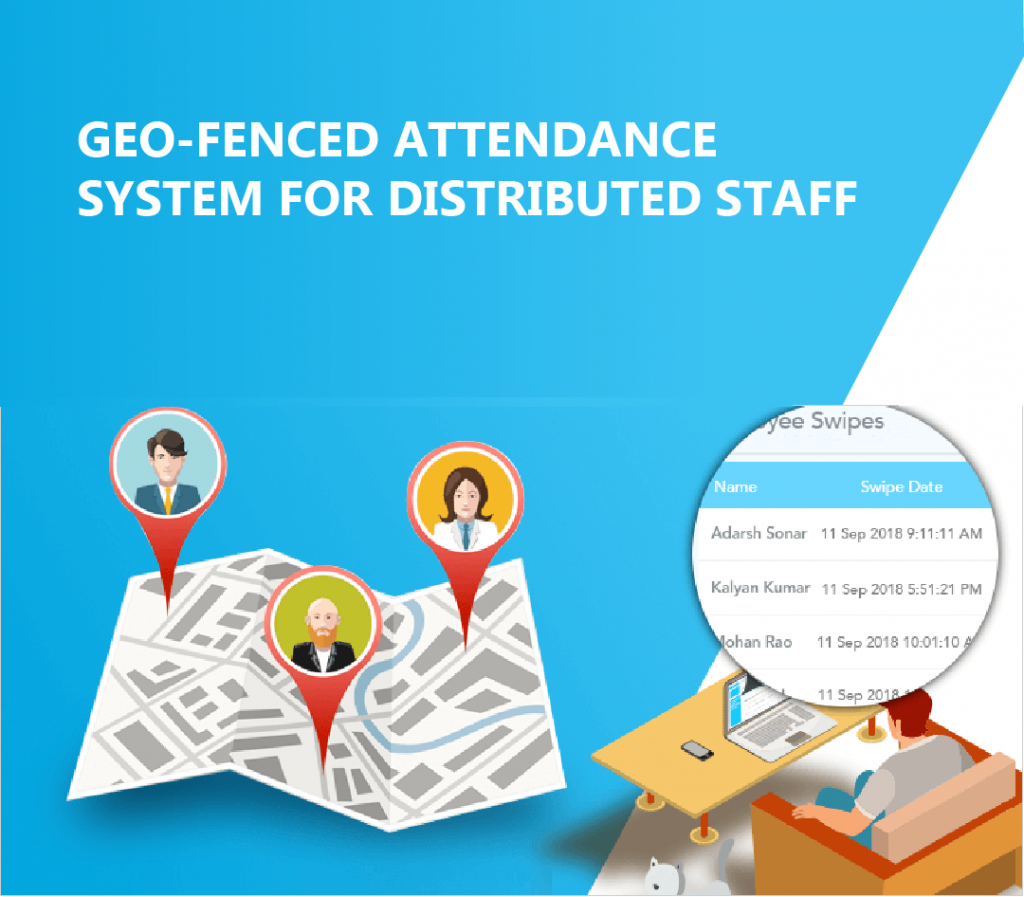
Nevertheless, keep in mind that geo-tagging does not mean continuous employee tracking. Many attendance systems capture location only when an employee takes an action, such as punching in/out.
Geo-Tagging vs GPS vs Geofencing: What Is the Difference?
These terms are related, but they do different jobs.
|
Technology |
Purpose |
Example |
| GPS | Identifies a device’s geographical position | Finding an employee’s coordinates |
| Geo-tagging | Adds location details to a digital record | Saving the location with an attendance entry |
| Geofencing | Sets a virtual boundary around a physical area | Checking whether attendance is marked within an approved site |
Ensuring attendance is logged from an Approved Site
A geofencing based attendance system will use virtual boundaries to enforce rules. A company will set up a boundary around their office/factory. The attendance system will monitor employees’ locations and apply rules based on whether they are inside or outside certain areas.
The area will be fixed using GPS; geo-tagging will note this in the log, and geofencing will apply rules in that area. Not all GPS attendance systems include geofencing, so make sure you check!
Why Would Businesses Want a Location-Based Attendance System?
If you have employees working in various locations, you will quickly understand why you would want a location-based attendance system.
You may have staff in your head office, warehouse, on site or at customer locations. It would be very stressful trying to keep track of multiple attendance sheets and spreadsheets.
With a location-based attendance system, you can log attendance digitally.
Managers can view the data on a dashboard instead of waiting for SMS and reports.
This technology offers many benefits. It means less paperwork and easier reporting. If your staff aren’t starting and finishing their workday from the same address, this would be very beneficial.
What Industries Can Benefit From Geo Tagging and GPS Attendance?
GPS attendance can help any industry where employees work across different locations. Some common examples include:
1. Building Firms
Construction companies have myriad employees working simultaneously on various sites. This makes GPS attendance quite useful for tracking attendance and records for contract and daily-wage workers across the company.
2. Transport and Delivery Service
Drivers and delivery staff may need to visit several locations in the same day. GPS attendance lets employers track where workers clock in and out and manage staff.
3. Real Estate Companies
Real estate teams have agents on projects, and they travel from one location to the other. Field attendance lets an organisation track staff working from home instead of commuting to the office daily.
4. Healthcare
Attendance for homecare specialists, field nurses, medical representatives, and others working from various locations is taken outside the office. GPS attendance will help them maintain compliance with this attendance data.
5. Manufacturing Industries
Many plants, warehouses, and production facilities may be involved. Location-based attendance can connect all sites, allowing staff to log in from other workplaces and helping teams manage shifts.
6. Facility Management Firms
Housekeeping personnel, security staff, technicians, and team leaders usually work from customers’ premises rather than the company’s offices. Location-based attendance will help record employees working in various places.
7. IT Firms
Information Technology firms with multiple offices or remote/hybrid teams can use location-based attendance. It helps oversee different work arrangements and keep attendance records in one place.
8. Sales-Driven Companies
Salespeople are constantly visiting customers, suppliers, trade companies, and partners. Combining location-based and journey information helps managers process data on past activities.
Real-World Examples of Geo-Tagged Attendance in India
The Indian government’s initiatives show several successful examples of how attendance works in large populations.
One successful programme is SARTHAK. It is an employee location tracking app India technology developed by the Madhya Pradesh State Electronics Development Corporation. The National e-Governance Division reports that the project has about 1.10 lakh users in more than 55 districts and 1,090 offices.
GIS attendance management features include mobile attendance, marking activities and trips, capturing location and images, calculating distance travelled, GPS locking, and GPS fencing capability. The platform also serves as a web reporting and administration tool.
Another successful example is the National Mobile Monitoring System (NMMS) application used for implementing the Mahatma Gandhi National Rural Employment Guarantee Scheme. The app helps record attendance using geo-tagged/date-stamped pictures and can work offline, recording attendance and uploading it once an internet connection becomes available.
The Ministry of Rural Development announced that attendance was recorded successfully in 95.21% of cases in the first half and 96.37% in the second half of the financial year.
The information concerns particular government projects. It shows how successful digital attendance could be, but these numbers cannot be interpreted as potential outcomes.
Things to Look Out for with an Employee Attendance Tracking System
In spite of the efficiency of GPS, there are a lot of other issues to be taken into account. Consider what your workforce and supervisors are doing every day.
- GPS Clocks: GPS can be utilized for employees’ clocking in/out.
- Geofencing: This feature comes in handy if you want to ensure your employees are clocking in/out in the established places.
- Shifts: This allows one to easily view the clocking in/out times and how many hours have been worked.
- Breaks: Employees can clock in/out taking breaks, and their supervisors can define the time, and duration of breaks.
- Site Visits: A great tool if you have a team that needs to log planned/complete/, and missed site visits.
- Map View: Managers can see field activity across multiple locations.
- Time Off/Home Working: Allows for common time off/home working requests to be logged.
- Reports/Dashboard: Less time needed to review attendance.
- Chat/Announcements/Tasks: Employees can communicate and log tasks within the platform.
Depending on how your workforce uses these tools, you may need one or more. If you have an office-based team, you may not need these tools.
Benefits Of Using GPS-Based Time Tracking For Your Company And Employees
Managers can see the context of when employees have logged their time. With GPS, reports can be compared across locations.
Manual work is minimised. Staff can also use mobile attendance. Someone who starts working at a client location won’t need to visit their head office to log their time in the biometric machine.
What’s more, if you use one platform to track employees’ attendance and site visits, they won’t need to send you separate reports.
So it depends on the software you use, the company’s attendance policies, and whether training sessions are delivered effectively. But what matters most is your concern towards your employees’ whereabouts.
Before making employees participate in a system that tracks their locations, organisations must inform every worker about what data they want to collect, when it’ll happen, its purpose, etc.
For example, India introduced the Digital Personal Data Protection Rules 2025 in November 2025. This included responsibilities, obligations, security measures, data minimisation, the purpose of data collection, and their impact.
GPS could vary significantly based on factors such as location and the availability of tall buildings. Therefore, the data received should be validated before it is considered accurate. Also, some small training sessions for employees are essential. They need to be informed about marking attendance, granting necessary permissions, and reporting technical issues.
Ways to Choose the Most Suitable GPS Attendance System
Ask these questions before deciding on one system:
- Is the app designed to make clocking in and out on a smartphone easy?
- Can it record location details each time an employee logs in?
- Does the app support geofencing if the business needs it?
- Can the system track employees across multiple offices and worksites?
- Does the app also allow you to record site visit history and map locations?
- Can employees control their break time, day off, and other matters such as working from home?
- Can you get attendance records quickly?
- Are the instructions for data privacy and access clear?
- Can the system accommodate the number of employees in the organisation now and in the future?
First, determine exactly what your business needs. Some firms operate in several office locations, but others employ hundreds of field employees.
Conclusion
A GPS Location Based Attendance System provides practical location information for your attendance records. This can help you manage employees working at offices, project sites, client sites, etc.
Geo-tagging and geo-fencing both provide location data. Depending on how you run your business and what features your employees need, choose the best option.
If your company has mobile teams, you may need more than just clocking in/out. Site visits, travel information, time off, working from home, and reporting can help you manage your workforce.
Convexicon simplifies attendance management. Employees can clock in and out, see how many hours they have worked, and view shift details.
We also provide an attendance solution for field teams. Employees and managers can see planned, completed and missed site visits. They can also view their route for the day on a map and open it in Maps. To know more contact us now +91 8800443333.
Frequently Asked Questions
What is GPS location-based attendance?
An attendance system that uses the device’s location service to track when employees clock in and out.
What is geo-tagging?
Adding geographical tags to attendance data so you know where you are.
What is the difference between GPS attendance and geo-fencing?
GPS identifies the device location. Geo-fencing uses a virtual boundary around a physical location. The GPS attendance app doesn’t have to use geo-fencing.
Which industries would use a location-based attendance system?
Construction, transport, property, healthcare, production, facilities management, IT and sales companies could use a location-based attendance system. Particularly if working across several locations.
Can I use GPS attendance across several workplaces?
Yes, GPS attendance applications can log location-based attendance when employees work across different offices, sites, meeting points, etc.